










Master Artist Sets: the palette as a foundation of thought
When an artist works for many years, their choices begin to repeat themselves. Not out of habit, but out of necessity. Certain colors return again and again. Certain mixes prove reliably effective. Certain pigments are consciously avoided. Over time, this repetition is not a limitation — it is clarification.
Master Artist Sets emerge precisely from this process. They are not theoretical palettes, nor were they designed to be “complete.” They are a record of a working method that has already been tested on paper, in real conditions, through failures, corrections, and repetition. They are the colors an artist actually uses, because they serve the way they see and interpret the world.
Some artists organize their work around structure and narrative. Others around atmosphere. Others around control, and others around flow.
For the end user, the value of a Master Artist Set does not lie in “painting like” the artist. It lies in starting from a palette that already has internal coherence. A palette in which the colors have a reason to exist next to one another. This allows someone who does not yet have the knowledge or experience to design such a cohesive palette on their own to work within a tested framework and to observe how choices influence the outcome.
In this section, I focus on artists who use the palette as a structural tool: to organize space, to convey light, to narrate place and experience. Artists who build their work through conscious mixing, balance, and control — not to restrict expression, but to support it.
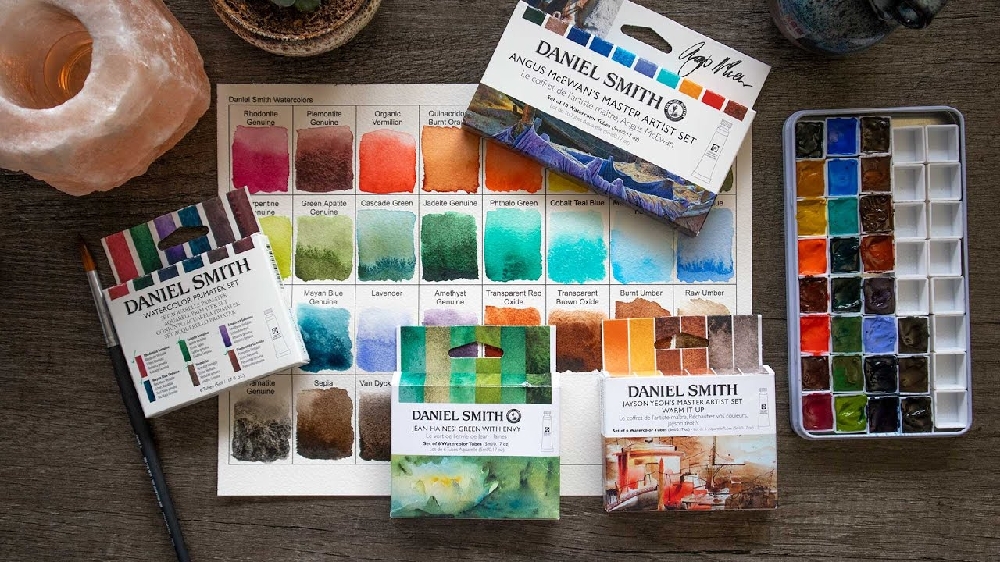
Jean Haines – color as movement
Jean Haines works with instinct, flow, and boldness. Her work is not built through strict control, but through feeling. Her palettes include intense, often unpredictable colors that “push” against one another on the paper.
For the artist working with these sets, the experience is not technical; it is liberating. You learn to trust color and to leave space for chance.
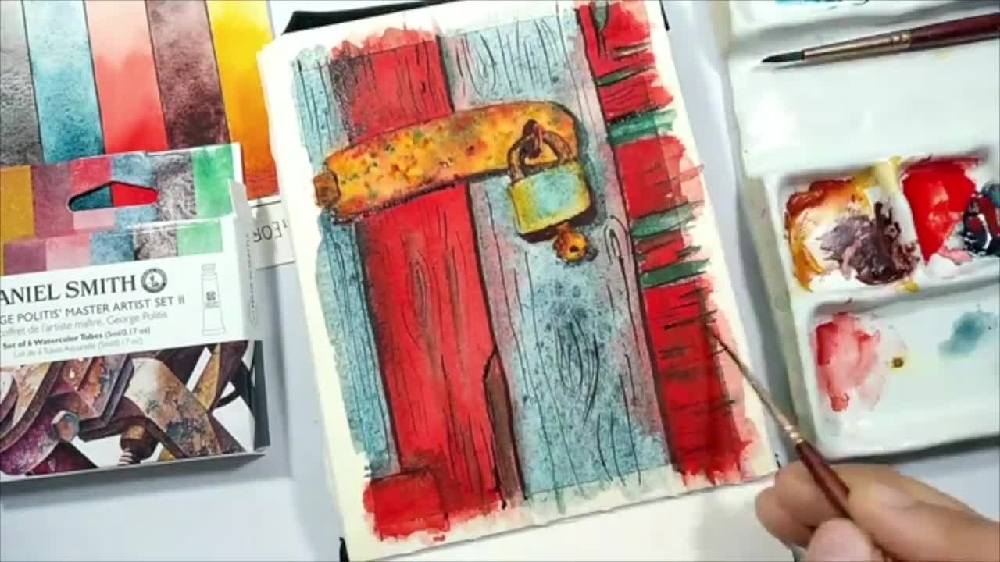
George Politis – light, place, and mixing
In George Politis’s work, light and atmosphere come before detail. His palettes are based on clean blues, warm earth tones, and granulating pigments designed for mixing directly on the paper.
They do not show you what to paint, but how to build depth with limited means.
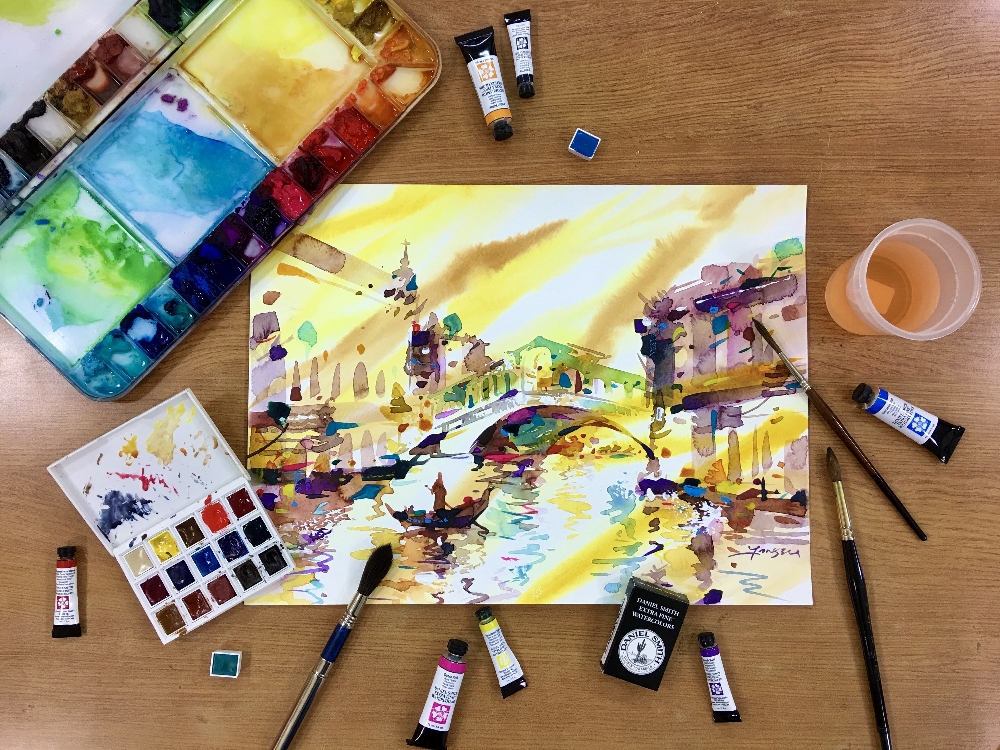
Jansen Chow – the rhythm of the city
Urban sketching, night scenes, intensity, and contrast. Jansen Chow’s palettes reflect an artist who works quickly, with clarity and a strong sense of space. The colors collaborate to convey atmosphere without excess, showing how a few well-chosen pigments can describe an entire world.
Angus McEwan – texture and weight
Angus McEwan works with body, texture, and granulation. His palettes are filled with earthy tones, neutrals, and heavy blues that “sit” on the paper.
Here, color is not surface, but material. And this radically changes the way you think about painting.
The palette as dialogue, not as limitation
The most beautiful aspect of the Master Sets is that they do not limit you. They challenge you.
They place you in dialogue with another way of seeing. They force you to think about mixes differently, to work with colors you might not have chosen on your own, to trust relationships between pigments.
Somewhere in that process, your own voice begins to form.
Not because you “learned” from someone else, but because you passed through the experience. The Master Set becomes a passage — not a destination.
And in the end…
Every artwork remains unique. Not because the palette changed, but because the gaze changed.
Master Artist Sets do not exist to make us all the same. They exist to remind us that color has character, and that art often begins with seeing the world just a little differently.
Myrto





